We are pleased to announce the publication of our new scientific article in the journal Results in Engineering :
Biner D., Hasmatuchi V., Dujic D., Münch-Alligné C. (2026)
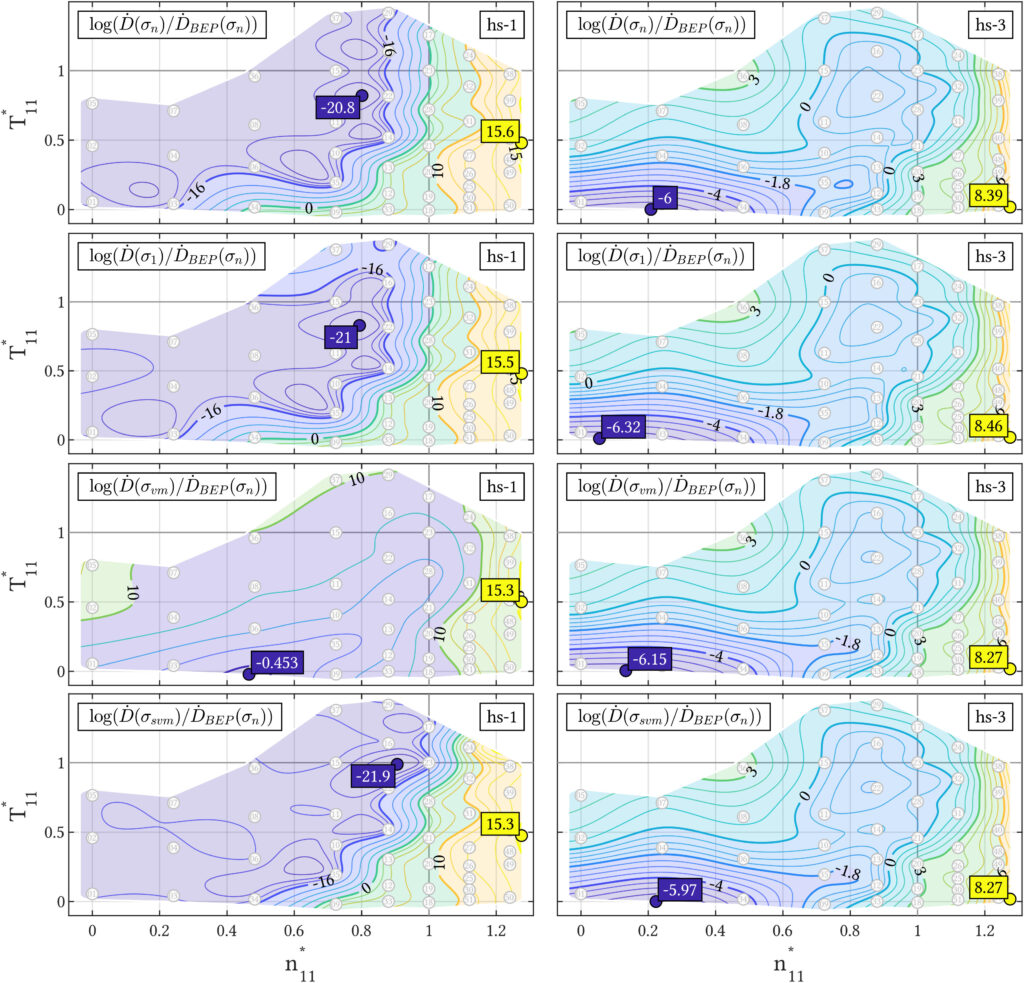
Fatigue design of Francis-type pump-turbine runners under flexible power generation
Available in Open Access from Elsevier : https://doi.org/10.1016/j.rineng.2026.109480
Context
With the massive integration of intermittent renewable energies, hydroelectric power plants are having to operate more flexibly (frequent start-ups and shutdowns, part-load operation, variable speed). These new operating regimes increase the mechanical stress on turbine wheels and pose major challenges in terms of structural fatigue and lifespan.
Aims of the study
The article proposes an advanced methodology for :
- Better prediction of Francis pump-turbine impeller fatigue
- Take account of multiaxial stress conditions
- Distinguishing between contributions High Cycle Fatigue (HCF) and Low Cycle Fatigue (LCF)
- Assessing the impact of start-up sequences
- Compare numerical results with experimental measurements on a prototype
Methodology
The study is based on :
- Unsteady CFD simulations coupled with structural models
- A critical plan (scaled normal stress method) for handling multiaxial stress states
- A quasi-stationary model for estimating damage for arbitrary operating trajectories
- Experimental validation on a 5 MW prototype pump-turbine equipped with a full power converter (FSFC)
Key results
- Conventional criteria (Von Mises, principal stress) can lead to unreliable estimates of critical fatigue zones.
- The critical plane approach significantly improves the robustness of predictions.
- Variable speed operation allows drastic reduction in start-up fatigue damage, This helps to extend the life of equipment.
- The model developed enables the impact of advanced control strategies on the mechanical integrity of machines to be quantified.
Financing
This work is part of the European project XFLEX HYDRO (Horizon 2020).