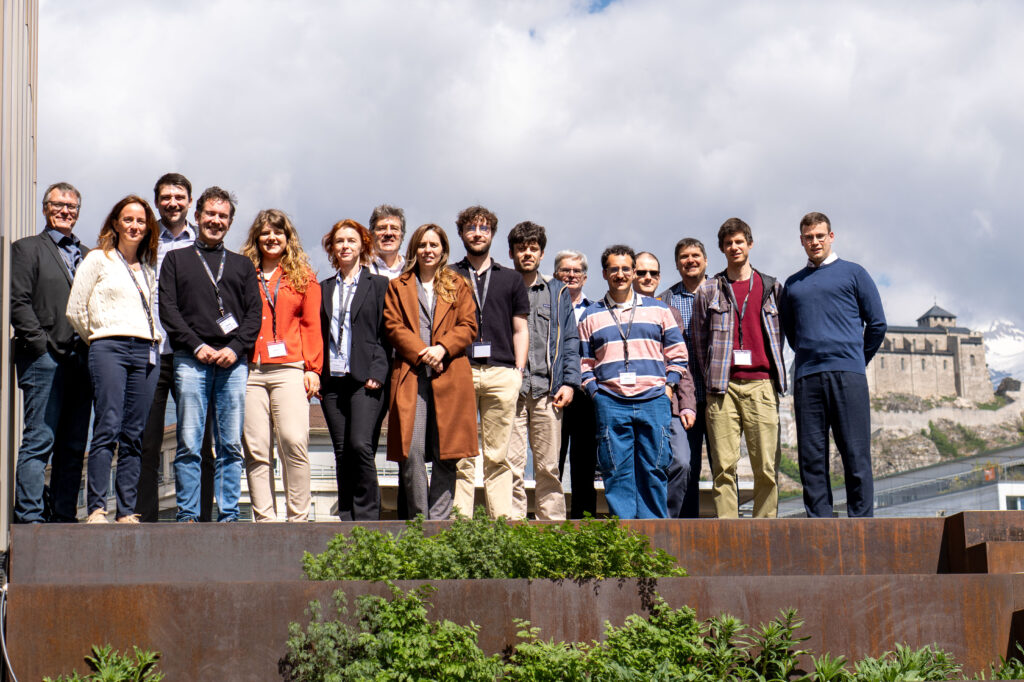
Last week, at the technical meeting of the European consortium ReVHydro held in Sion, Francesco Lagravinese, a doctoral student at the Hydro Alps Lab, presented a major advance in our understanding of partial-load instabilities. His work addresses a major challenge: how to accurately detect and predict the Rotating Vortex Rope (RVR) without exploding numerical computation costs?
Predicting the «torch» without overloading supercomputers
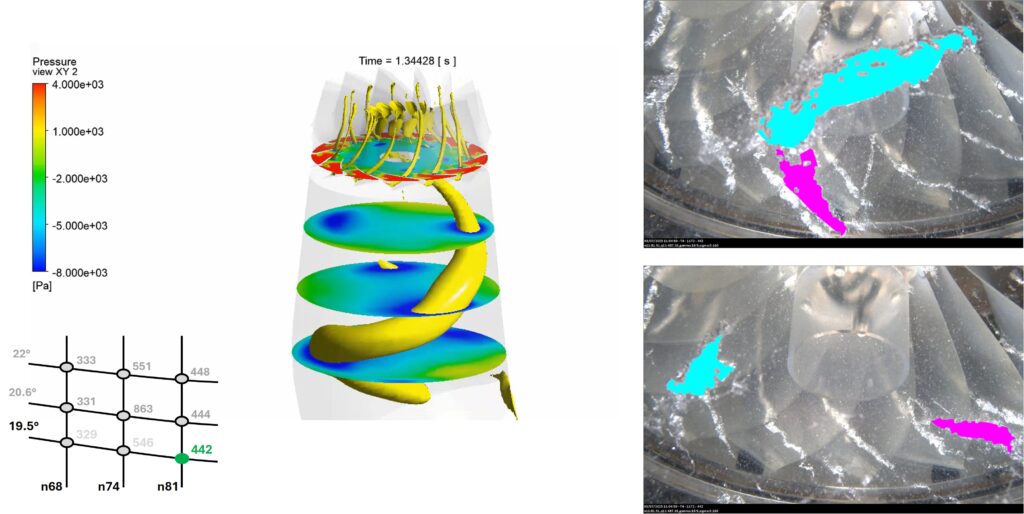
RVR is the vortex that appears at the impeller outlet when the turbine is operating outside its optimum efficiency point at partial load. If poorly controlled, it generates severe pressure pulsations that prematurely fatigue the structure. Francesco outlined a game-changing strategy for rationalising costs:
- Optimised CFD methodology: instead of using time-consuming simulations, it has proved that a coarser mesh and a less restrictive time step can reliably detect pressure fluctuations linked to the RVR.
- Mapping the efficiency «hill»: this work has enabled us to isolate precisely the critical «RVR max» region on a matrix of 9 operating points (combining different guide openings and specific speeds).
- Experimental validation: this numerical approach has been validated by real pressure measurements carried out in the laboratory by GE Vernova, confirming that the model perfectly follows the observed physical behaviour.
A springboard for IAHR 2026
These results are just the first step. By effectively mapping this critical zone, Francesco Lagravinese is laying the foundations for the development of control systems to mitigate the RVR and for the creation of Reduced Order Models (ROMs). For the Lab's partners, in particular GE Vernova and the team led by Prof. Michel Cervantes from the University of Luleå (LTU), involved in this part of the project, this breakthrough offers a concrete way of improving the flexibility of existing turbines while simplifying the numerical optimisation phases. This work will be presented in greater detail this autumn at the’IAHR 2026 in Iguaçu.