Safety and sizing of butterfly valves
Over the years, operators and owners of hydroelectric schemes have noted a gradual loss of knowledge and expertise in the design and sizing of butterfly valves. Yet this equipment plays an essential role in the safety of the facilities and their environment. At the same time, recent advances in numerical simulation now enable much more detailed analysis of transient phenomena, which must now be systematically incorporated into the design of these safety devices.
It was against this backdrop that the WhiteButterfly, a project SFOE P+D supported by the Swiss Federal Office of Energy. Its main aim is to improve the safety of hydroelectric schemes in the long term by reconstructing, structuring and disseminating the essential knowledge relating to butterfly valves.
Project objectives
The project aims to develop a white paper, This document will be made available free of charge to owners and operators of hydroelectric schemes. This reference document will describe a clear and rigorous methodology for :
- establish a complete and coherent specifications for the design of a butterfly valve,
- define the expected evidence from manufacturers to validate the design and sizing with the client,
- to support operators in the verification of fitness for service of existing butterfly valves.
Approach and organisation of work
The project focuses on three complementary axes :
- Model-scale studies
This area aims to define the methodological framework for numerical studies, specifying the assumptions, parameters and limits of validity of the calculations. - Full-scale validation
The approach developed is validated by a systematic comparison between experimental measurements and simulation results on a real valve. - Drafting the white paper
The white paper summarises all the results and proposes technical specifications designed to guarantee the safety of the structures and their environment.
The structure of the white paper, defined in the first year of the project, adopts a pragmatic approach inspired by SIA standards. A reference diagram guides the reader through all the key stages, from the feasibility study to the butterfly valve commissioning tests.
Risk analysis and load cases
The project began with a risk analysis to identify the critical elements of a hydroelectric scheme. This analysis forms the basis for defining the load case to consider, both when sizing a new valve and when assessing the serviceability of an existing valve.
Case studies
The gate at the Péroua site was chosen as the reference. With a diameter of 3 metres, it is located on a Grande Dixence development and plays a safety role between the Fionnay storage basin and the Nendaz plant.
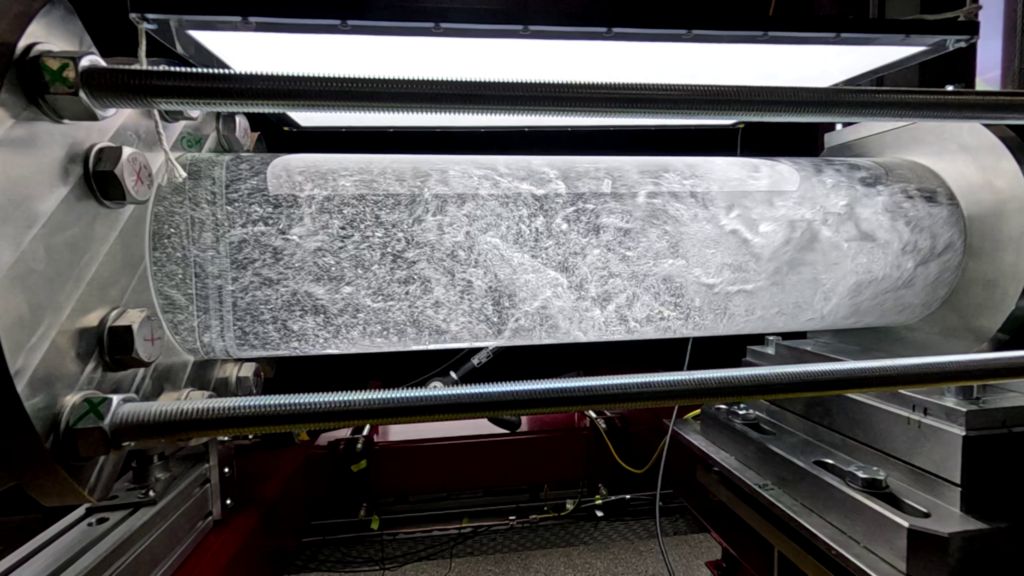
A reduced model valve (diameter 150 mm, scale 1:20) was designed, manufactured and installed on the HES-SO test bench in order to study the behaviour of the valve with and without the cavitation phenomenon.
Flow without cavitation, flow velocity 2.6 m/s, angle 60° (90° = open) :
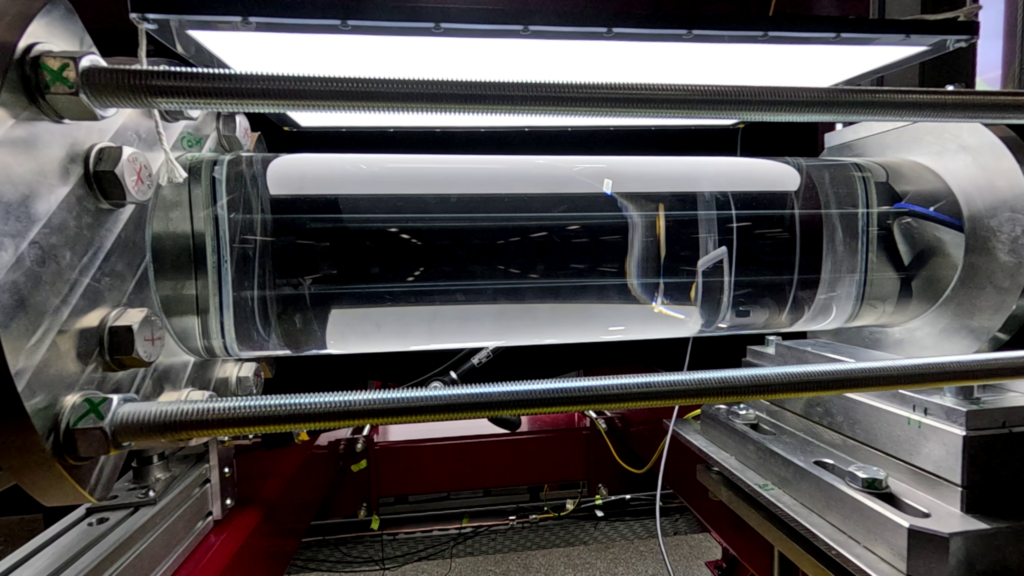
Flow with cavitation, flow velocity 2.6 m/s, angle 60° (90° = open) :