Whilst large pumped-storage power stations already provide around 4 GW of flexibility to the Swiss transmission grid, decentralised hydro storage is emerging as a competitive solution to the new balancing requirements of distribution networks, driven by the growth of photovoltaics and electric mobility. It is against this backdrop that the work carried out by HAL (Line Moret, Noé Babey, Olivier Pacot, Cécile Münch-Alligné) fits, stemming from the HiDeStor project and carried out jointly with Mhylab (Alberto Bullani, Aline Choulot, Laurent Smati, Vincent Denis) on behalf of the SFOE.
The study demonstrates the technical and economic benefits of small- and medium-capacity pumped-storage power stations (5 to 10 MW for daily operating cycles of 3 to 6 hours) based on the interconnection of existing reservoirs used for irrigation, artificial snowmaking or hydroelectric power generation. This approach significantly reduces civil engineering costs and the environmental footprint, whilst facilitating local acceptance.
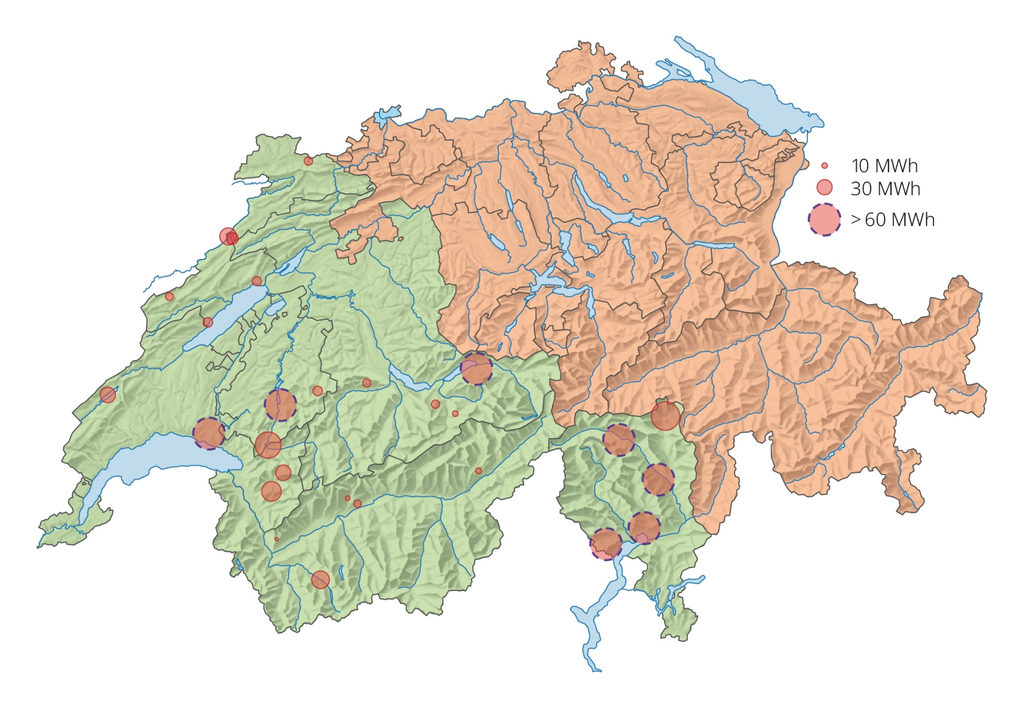
A methodology combining a detailed cantonal inventory with geospatial modelling based on graph theory applied to Swisstopo data has yielded significant results:
- 27 high-potential sites have been identified across 7 cantons, covering nearly half the country’s territory, with a combined capacity of 895 MWh and head heights ranging from 50 to nearly 1,000 metres.
- An estimated national theoretical potential of approximately 1.7 GWh for connection distances of less than 2 kilometres between two reservoirs.
- A levelised cost of storage (LCOS) of between 0.05 and 0.12 CHF/kWh, making these facilities a competitive and sustainable alternative to lithium-ion batteries for daily load smoothing and system services.
Find out more about the full analysis, the site selection criteria and the detailed economic comparison in the article published on Bulletin.ch.